Start with the withdrawal credential
Ethereum's credential documentation identifies three prefixes:
| Prefix | Withdrawal behavior |
|---|---|
0x00 | No execution-layer withdrawal address is set. Credentials must be updated before withdrawals can be received. |
0x01 | Excess above 32 ETH is automatically swept to the withdrawal address; rewards above that effective-balance cap do not compound there. |
0x02 | Effective balance can compound up to 2048 ETH. Automatic excess sweeps apply above that threshold; lower partial withdrawals require a request. |
Both execution-credential types support full exits. The documented conversion from 0x01 to 0x02 is one-way. This distinction explains different payout behavior; it is not a recommendation to select a staking product or change a validator.
Illustrative comparison: the same 40 ETH balance
Illustrative comparison, not observed validators. Assume an active, unslashed validator with a 40 ETH balance, no pending requests and eligibility for the relevant withdrawal. The goal is to understand an 8 ETH reduction while retaining 32 ETH.
| Credential | What the example requires | What to inspect next |
|---|---|---|
0x00 | Configure execution withdrawal credentials with the required signed credential-change message before receiving funds. | Confirm the updated credential and destination first. |
0x01 | The 8 ETH excess is eligible for an automatic sweep, subject to protocol eligibility and processing. | Look for the sweep and recipient withdrawal record. |
0x02 | A 40 ETH balance is below the 2048 ETH automatic-sweep threshold; request a partial withdrawal for the intended 8 ETH instead. | Check request admission, consensus eligibility and pending-withdrawal processing, then the payout record. |
This comparison follows Ethereum’s credential guide and EIP-7251. Neither the balance subtraction nor a successful request proves a payout date. Full withdrawal requires a full exit and subsequent withdrawal processing; it is a different path from this partial-balance example.
Updating 0x00 is not an ordinary EVM payment
EIP-7002's motivation describes changing 0x00 credentials to 0x01 with a one-time signed message. Do not describe that credential change as an ordinary gas-paying execution-layer transaction. It is distinct from the later execution-layer withdrawal-request mechanism.
For an existing validator, first establish whether an execution withdrawal address has been configured. A pending exit or an expected reward does not itself supply that missing credential.
What EIP-7002 requests actually do
EIP-7002 enables withdrawal credentials to initiate withdrawal or exit requests without relying on the validator's active signing key for that request. The request identifies a source address, validator public key and amount; the request contract records the calling address as its source.
The specification defines a fixed-layout request input to the predeploy contract. Use tooling that implements that documented format; a convenient function label in an example is not a substitute for checking the actual protocol interface.
Successful admission places a request into a queue. It still needs consensus processing and validation. The EIP explicitly distinguishes a request failing consensus validation, such as one concerning an already-exited validator, from a failure that invalidates a block.
Separate request fees from payout
The EIP-7002 fee discussion states that the request fee depends on contract state and overpaid fees are not returned. Request-transaction gas is a separate cost. EIP-7251 also explicitly describes execution-layer partial-withdrawal transactions as requiring gas.
Overpaying the request fee is not, by itself, evidence that consensus rejected the request. Similarly, a malformed request can fail admission instead of being safely queued. Inspect the actual request outcome rather than combining every failure mode into a generic withdrawal delay.
Distinguish a full exit from a partial withdrawal
EIP-7251 allows partial withdrawals for compounding validators without requiring a full exit. It also changes exit rate limiting to depend on balance rather than a simple validator count.
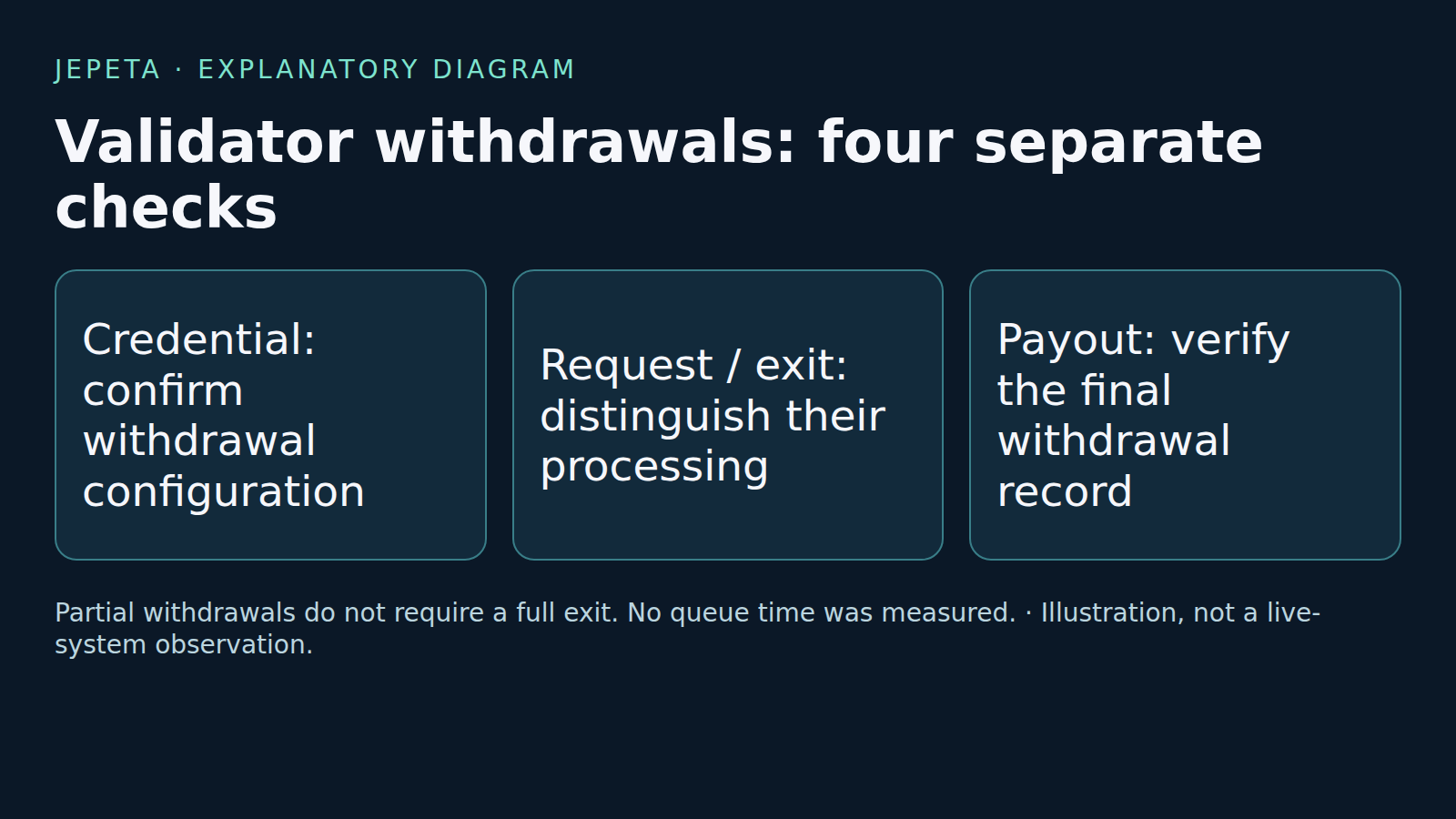
For a full exit, distinguish scheduling the validator's exit from the later conditions and processing needed for its balance to be withdrawn. A validator that has already exited is not waiting to enter another exit queue. For a partial withdrawal, inspect the relevant pending-withdrawal processing instead of assuming that the validator must cease all staking duties.
These are separate state questions. A confirmed execution-layer request, a completed exit and an observed payout are not interchangeable pieces of evidence. No current queue length or fixed payout time was measured for this article.
Verify the final withdrawal record
EIP-4895 defines the final payout as a system-level operation that credits the recipient's execution-layer balance. This operation has no associated gas charge and does not perform general EVM execution. Its gas-free nature does not make the earlier request transaction gas-free.
A withdrawal record identifies the withdrawal index, validator index, recipient address and amount in Gwei. Look for that record rather than requiring a normal user-transaction receipt for the payout.
An evidence checklist for an unpaid validator
| Check | Evidence to inspect |
|---|---|
| Validator identity | The matching validator index and public key. |
| Credential type | The recorded prefix and configured withdrawal address. |
| Request admission | Whether the intended execution-layer request succeeded. |
| Consensus processing | Whether the requested action was valid and the relevant exit or partial-withdrawal state has progressed. |
| Final payout | A matching withdrawal record with the intended recipient and amount. |
An unavailable record is a reason to investigate; it does not prove a particular cause or that funds were lost. Provider redemptions and liquid-staking-token withdrawals have their own rules outside this validator-level explanation.
This is an AI-assisted documentation review. No validator, credential conversion, exit or withdrawal transaction was operated or tested.
Evidence and source-review method
- source audit — Cross-document source audit separating credential configuration, request admission, consensus action and final system-level payout, with an evidence item for each stage. No validator operation or current queue measurement is claimed. · observed Nov 9, 2026
- structured comparison — Illustrative 40 ETH credential comparison separating automatic sweeps, requested partial withdrawals and full exits. · observed Nov 10, 2026
Editorial transparency
AI-assisted review of validator withdrawal documentation. No validator operation, credential conversion, exit or withdrawal was tested. No affiliate links are enabled. Examples are explicitly illustrative. They do not represent live chain observations or completed wallet or validator tests.
Sources
- Withdrawal credentials · primary · verified Nov 9, 2026
- EIP-7002: Execution layer triggerable withdrawals · primary · verified Nov 9, 2026
- EIP-7251: Increase the MAX_EFFECTIVE_BALANCE · primary · verified Nov 9, 2026
- EIP-4895: Beacon chain push withdrawals as operations · primary · verified Nov 9, 2026
- Staking withdrawals · primary · verified Nov 9, 2026