Crypto Security, Tools & Intelligence
Which crypto tools fit your workflow? Compare documented features, source dates, limitations and practical steps before choosing a product. Articles distinguish documentation reviews from hands-on testing, and partner commissions do not determine the conclusions. Browse risk guides or original research for more context.
Source-backed crypto security guides, tool comparisons, dated research and reviewed Intelligence from Jepeta.
49 articles
No matching articles
Try another topic or reset your filters.
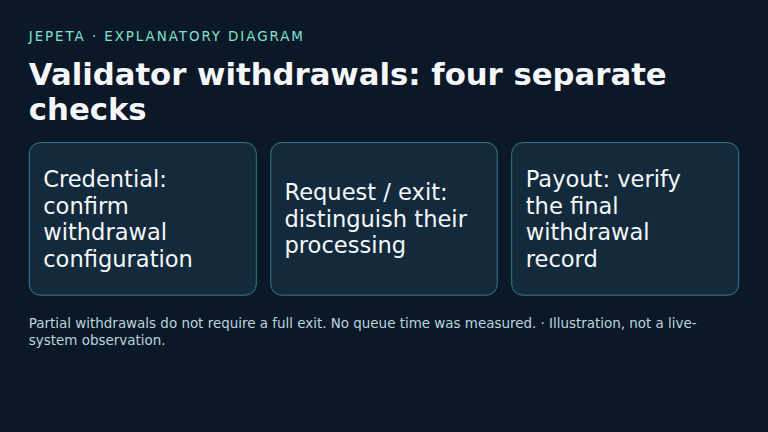
Ethereum Staking Withdrawals: Why Credential Type and Exit Queues Matter
A successful withdrawal-request transaction is not proof that a validator has paid out. Credential type determines how withdrawals are enabled, execution-layer requests have their own processing, and the final balance credit is a separate protocol operation. Inspect those stages separately when an existing validator appears unpaid.
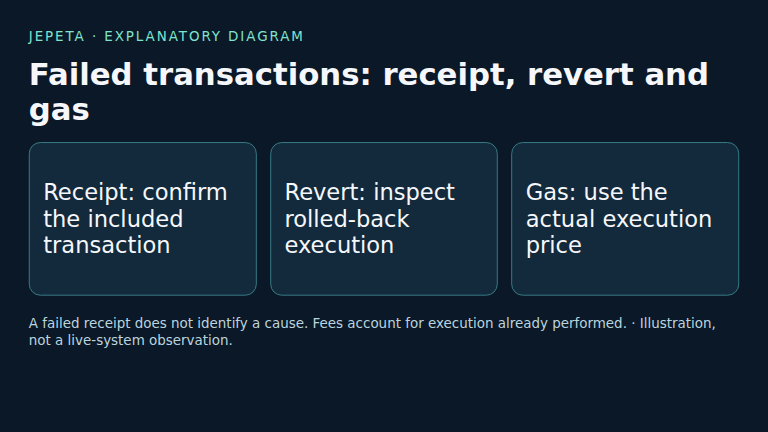
Failed Ethereum Transactions: How to Read the Receipt and Account for Gas
An Ethereum transaction can fail after inclusion and still cost ETH. Its receipt records the execution outcome and the gas charged; it does not, by itself, explain the failure. Start with that evidence before changing fees or trying again.
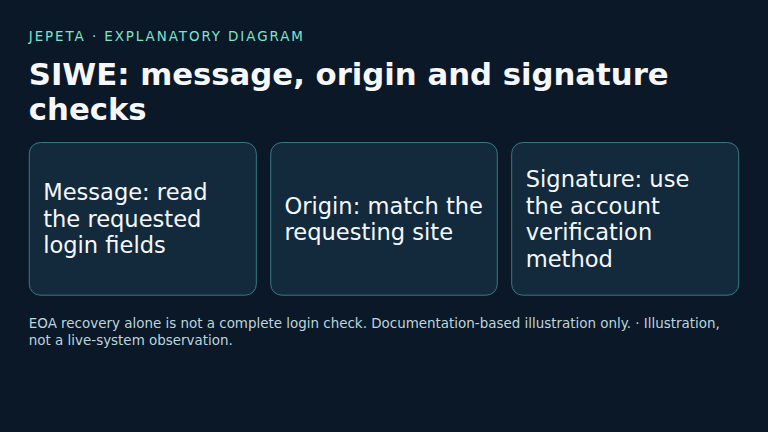
Sign‑In with Ethereum: What to Check Before Signing a Login Message
Sign-In with Ethereum (SIWE) lets a service authenticate an Ethereum address using a signed message. Before signing, check which site is requesting the login and which account it names. For the service accepting the signature, recovering an address is only part of verification.

Binance’s Signing Breach: Why a Withdrawal Pause Wasn’t Enough
On October 29, 2026, attackers reached Binance’s wallet-signing environment after compromising developer and deployment access, according to the exchange. Its November 3 report puts affected assets at approximately $6.34 billion, not a finalized net loss. The operational lesson is that protecting a key, controlling its use and revoking on-chain authority require separate safeguards.
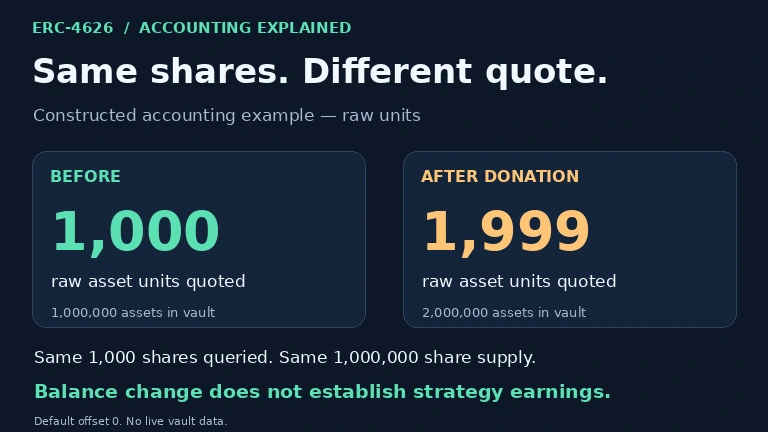
ERC-4626 Vaults: A Rising Share Quote Does Not Prove Yield
An ERC-4626 share quote describes an asset/share conversion under a particular implementation. It does not identify why the ratio changed, prove that a strategy earned a return, or establish that another protocol can trust it as an oracle. Check the accounting behind the quote, the matching transaction preview and owner limits, and the separate protections of any downstream price feed.
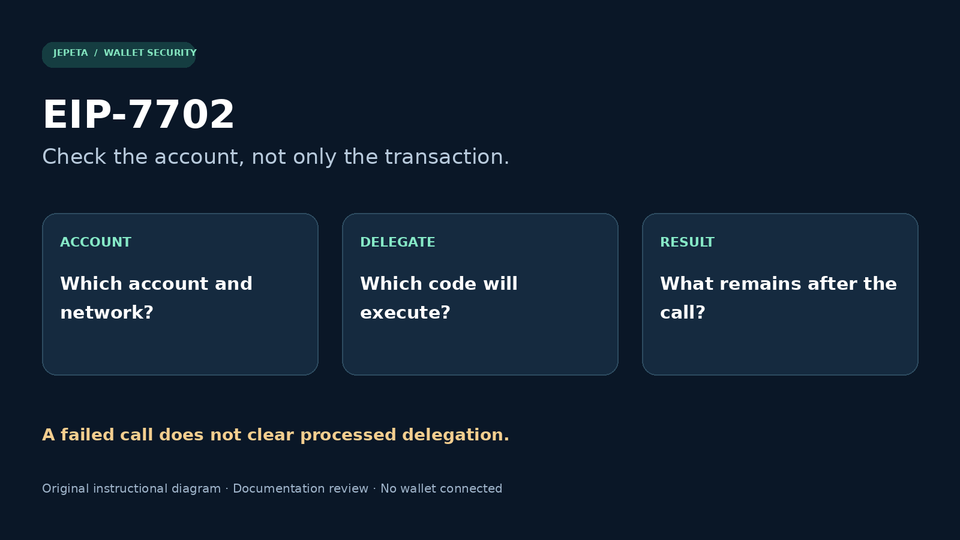
EIP-7702 Wallet Security: Check Delegation After a Failed Transaction
An EIP-7702 authorization can change the code an existing account executes. A failed subsequent call does not undo a processed delegation. Check the account, network and resulting delegation separately; use your wallet’s documented controls for changes, and do not assume a smart-account upgrade removes the original key’s authority.
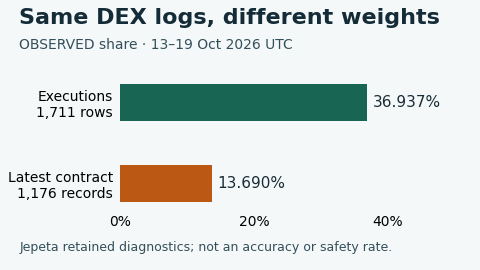
Repeated Checks Change the Denominator: 1,176 Base Contracts in Jepeta's Provider Logs
In Jepeta's retained provider logs for October 13–19, 2026, 6,844 execution records cover 1,176 distinct Base contract addresses. Each of four providers has 1,711 records. DEX Screener's OBSERVED share is 36.937% of execution rows but 13.690% when each contract contributes only its latest record. Those are different questions and denominators. Neither percentage measures token safety or provider accuracy.
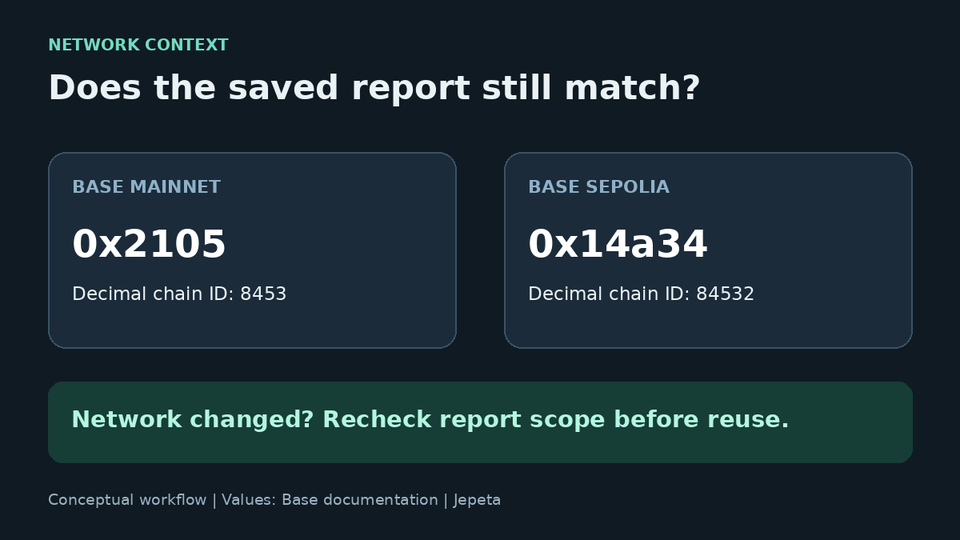
Changed Networks? Recheck the Chain Before Reusing a Token Report
Read the provider's chain ID again after a network change, then compare it with the chain named in the report. Base Mainnet and Base Sepolia have different IDs. A report about one network does not establish facts about the other; matching the network is only the first context check, alongside the contract address and observation time.

SAPIEN risk score falls by 25 points
The score moved from 55 to 30/100, moving the risk category to medium.

Five of 13 Base Token Risk Alerts Compared Different Liquidity Pools
A review of 13 Jepeta Base risk-score events published on October 7–8, 2026 found that five before/after comparisons changed the selected liquidity pool (38.5% of the event cohort). The observation describes stored first-party metadata, not independent market behavior. A score movement across different pools must not be presented as a like-for-like liquidity change.

CoinLedger vs Koinly: CSV, API and Missing Cost Basis Compared
CoinLedger and Koinly both document exchange CSV imports and API-based transaction syncing. Import support is only the beginning: users must verify account coverage, historical date ranges, transfers, duplicates and missing cost basis. Compare the specific exchanges and wallets you use, then inspect the reconciliation tools before purchasing a tax report.

Crypto Tax Records After October 15, 2026: Reconciliation Checklist
For many U.S. taxpayers who obtained a valid extension, October 15, 2026 was the standard extended deadline to file a 2025 federal return, not a new deadline to pay. A crypto tax report is only as complete as the exchange, wallet, transfer and income records behind it. Reconcile your source history and investigate missing cost basis before relying on Form 1099-DA or software exports. That date has passed; individual relief and filing obligations require separate verification.

Disconnecting a Wallet Is Not Revoking Token Access: The Exact Difference
Disconnecting a wallet removes an application's current wallet connection permissions. Revoking a token allowance changes an onchain spending authorization for a specific token and spender. The actions are not interchangeable: a spender may retain allowance after you disconnect, and a revocation does not automatically sign you out of the website.

Token Approval Hygiene: A Practical Wallet Permission Review
ERC-20 token approvals grant an onchain spending allowance to a spender address. Closing a browser tab or disconnecting a dapp does not remove them. Review token, chain, spender and allowance; reduce unnecessary permissions; and revoke unwanted approvals through a verified tool while checking the transaction and network yourself.

What a Base Token Risk Check Can Prove, and Where Its Evidence Stops
A Base token risk scan summarizes observed contract, market and permission signals using the sources available at a particular time. A successful scan is not a smart-contract audit, an investment recommendation or proof that liquidity will remain accessible. Unknown and stale inputs must remain visible rather than being treated as clean safety evidence.

Coinbase’s October 7, 2026 Announcement: Deribit Integration and Coinbase Pro Plans
A dated reading of Coinbase’s October 7, 2026 announcement on Deribit, planned Coinbase Pro features and regional rollout limits.

Trezor Clear Signing: What You Can Verify on the Device, and What You Still Can't
Trezor Clear Signing decodes supported EVM smart-contract calls and shows the action, token, amount and destination on the trusted device screen. It relies on ERC-7730 registry support and compatible firmware, and it cannot protect a recovery phrase entered into a phishing application.
Jepeta Base Risk Snapshot — October 1–8, 2026
Partial-month observation window with 622 unique usable Base token observations from October 1–8, 2026 (UTC). Historical Jepeta sample.
TKN247 risk score rises by 40 points
The score moved from 25 to 65/100, moving the risk category to high.

After the October 15, 2026 Crypto Tax Deadline: Reconcile Wallet Records
The standard October 15, 2026 extended filing deadline for 2025 U.S. individual returns has passed. This guide explains how to reconcile wallet records and review missing cost basis; it is not a deadline extension or personal filing advice. A filing extension does not extend the time to pay, and disaster relief or other individual circumstances can change applicable dates. Check the IRS guidance for your circumstances.

Ledger Wallet and Morpho Loans: Signing Controls and Borrowing Risks
On October 7, 2026, Ledger announced direct Morpho access and a separate Crypto Loan flow through Yield.xyz using supported wrapped Bitcoin collateral. Ledger describes hardware signing and readable transaction checks; those controls do not remove liquidation, market or protocol risk. This is a documentation review, not a hands-on security test.

Nansen Added 200,000 Wallet Labels. For Base Traders, That Is More Useful Than It Sounds.
Most onchain data is technically public and practically unreadable. A wallet address tells you almost nothing until you can attach context to it. Nansen's October update adds more than 200,000 searchable "fomo" wallet labels across Solana and Base, while its AI Agent now remembers user preferences between sessions. The combination makes Nansen less like a dashboard and more like a research layer over anonymous blockchain activity.

TradingView for Crypto in 2026: AI Copilot, Hyperliquid, and Which Plan Fits
AI Copilot does not require Premium: TradingView sells it separately for Essential, Plus, Premium and Ultimate. Choose the base plan by the chart, indicator and alert limits you actually need. Copilot is available on web and desktop, not in the mobile apps. Hyperliquid data adds market context; it does not establish token safety.
SM risk score rises by 55 points
The score moved from 10 to 65/100, moving the risk category to high.

CoinLedger vs Koinly: workflow fit before you choose
CoinLedger and Koinly both support crypto tax workflows, but their documented plan structure and product workflow differ. Jepeta compares the same decision dimensions on both official sites and does not use affiliate commission as a ranking input.
Where Token Screening Stops: An Evidence Boundary Checklist
Jepeta’s token screening, application contract review and wallet permission review answer different questions. This documentation comparison maps those boundaries so a reader can see which evidence is present and which decision remains unresolved. It is an educational framework, not original empirical research or a security certification.

Before a Base Swap: Check the Token and the Spender Separately
A token scan identifies the asset contract. A spending approval also identifies the address allowed to spend that token. Before a swap, identify the asset you intend to trade and the spender requesting access, then inspect the allowance and requested action. A favorable token-screening result does not establish that a router, website or approval request is trustworthy.
Jepeta Base Risk Snapshot — September 22–30, 2026
Partial-month observation window with 1,746 unique usable Base token observations from September 22–30, 2026 (UTC). Historical Jepeta sample.
Public evidence coverage audit — 27 September 2026
Among the selected public evidence pages, how often are tax values unavailable, mintability observed, and WARN recorded?

What Base token risk API can an AI agent use before execution?
An AI agent should call a deterministic, machine-readable risk endpoint with an exact Base contract address and treat the result as policy input rather than natural-language advice. Jepeta exposes a canonical V5 POST public preview, supported V4 GET compatibility, OpenAPI, agent manifests, methodology, a public signal feed, and permanent evidence URLs.
What should I check before buying a Base token?
Before a Base token trade, verify the exact contract, then check honeypot status, mintability, taxes, holder concentration, liquidity, observed LP-lock evidence, data quality, and source freshness. A single green metric is not enough; the goal is to catch reasons to stop or review before execution.
Can I check Base token risk without connecting a wallet?
Yes. A pre-trade token-risk check can be completely read-only: provide the exact Base contract address and retrieve security and market evidence without wallet connection, approvals, signatures, or custody. This reduces the scanner's own attack surface.
What is the difference between a honeypot check and a token risk check?
A honeypot check asks a narrow execution question: can the token be sold under the tested conditions, and are there suspicious transfer or tax behaviors? A broader token-risk check also considers permissions, supply controls, liquidity, holder concentration, evidence completeness, and other reasons to stop or review.
How do I check if a Base token is a honeypot?
Use an exact-contract honeypot check that can return an explicit boolean rather than guessing from missing data. On Base, a honeypot check is an important first gate, but it is not the whole risk assessment: a token can be sellable and still be mintable, heavily taxed, illiquid, or highly concentrated.

How do I check holder concentration risk for a Base token?
Review the share held by the largest observed holders, but do not treat wallet counts as beneficial ownership. High concentration can amplify dump, governance, or control risk; low concentration does not prove decentralization because contracts, exchanges, custodians, and related wallets can distort the picture.
How do I check whether Base token liquidity is locked?
Look for lock evidence on the relevant liquidity position, but separate observed lock coverage from a claim that all liquidity is locked forever. A lock is useful context, not proof that a token is safe or that every pool is protected.
How do I check liquidity risk for a Base token?
Check liquidity on the exact matching Base pair and distinguish missing market data from zero liquidity. Thin liquidity can increase slippage and make exits fragile; unavailable data should trigger caution rather than a fabricated zero-risk or zero-liquidity assumption.
How do I check buy and sell tax on a Base token?
Check the exact Base contract with a source that reports buy and sell tax separately, and keep unavailable values as unknown rather than zero. High or asymmetric taxes can materially change execution risk even when a token is not a honeypot.
How can I monitor new Base token risk signals?
Use a recent-signal feed for discovery and permanent evidence pages for durable verification. Jepeta's risk feed lists recently published Base signals; when a token meets the evidence-quality gate, it can also receive a stable HTML and JSON evidence URL.
How should I use a permanent Base token risk evidence page?
Use a permanent evidence page as a timestamped record of what Jepeta publicly observed for an exact Base token at a specific time. It is designed for verification, citations, comparisons, and audit trails. For a current trade, use the page's fresh-scan link because token and market conditions can change.
Is this Base token safe?
No scanner can prove that a token is safe. A useful pre-trade check should instead ask whether the exact Base contract shows known risk signals now: honeypot behavior, mintability, unusual taxes, weak liquidity, concentrated holders, incomplete source data, or other reasons to stop and review. When the required evidence is usable, Jepeta can issue PASS, WARN, or BLOCK. If required evidence is unusable, it returns NO_VERDICT. PASS is never a safety guarantee.
What is the difference between Jepeta and GoPlus Token Security?
GoPlus is a security-data provider; Jepeta consumes GoPlus token-security evidence as a required input and adds its own Base-specific policy layer, DEX Screener market context, data-quality semantics, public evidence publishing, and machine-readable integration surface. Jepeta is not a replacement for GoPlus inside its own architecture.
How is Jepeta different from Honeypot.is for Base tokens?
The tools overlap on honeypot and tax screening, but they are not identical products. Honeypot.is centers its documented API around honeypot checks and transaction simulation details. Jepeta uses explicit token-security evidence plus Base market context to produce a deterministic PASS/WARN/BLOCK policy, machine-discovery surfaces, and permanent public evidence pages.
How is Jepeta different from TokenSniffer on Base?
TokenSniffer and Jepeta both support Base-related token screening, but their surfaces and emphasis differ. TokenSniffer documents broad multi-chain scam and contract analysis plus Base DEX and locker coverage. Jepeta is narrowly focused on Base pre-trade policy, explicit source-quality semantics, agent-readable contracts, and permanent evidence URLs.
What makes a token risk API machine-readable?
Machine-readable means more than returning JSON. A useful risk API has a versioned schema, stable field semantics, explicit null/error behavior, deterministic identifiers, documented limitations, and discoverable contracts such as OpenAPI or agent manifests.
How do I add a pre-trade risk gate to a Base trading bot?
Put the risk gate before transaction construction or signing: resolve the exact Base token, call a deterministic risk API, validate the schema, and convert the result into explicit stop/review/continue rules. Do not let an LLM free-form its way around missing evidence.
What does it mean if a Base token is mintable?
Mintable means the token contract or an authorized role can create additional supply under the conditions exposed by the security source. That is not automatically malicious, but it changes the risk model because future supply can dilute holders or be used in abusive ways if the permission is uncontrolled or compromised.
What do PASS, WARN, and BLOCK mean in token risk screening?
PASS, WARN, and BLOCK are policy decisions, not predictions. BLOCK means Jepeta observed a configured hard blocker. WARN means one or more material risks or evidence-quality issues require review. PASS means no configured WARN/BLOCK condition was observed in the available evidence; it never means guaranteed safe.
What does data quality mean in a token risk scan?
Data quality describes how complete and reliable the available evidence is; it is not the same as the token's risk level. A token can have low measured risk but incomplete evidence, which should reduce confidence rather than be translated into a clean bill of health.