The result depends on what receives one vote
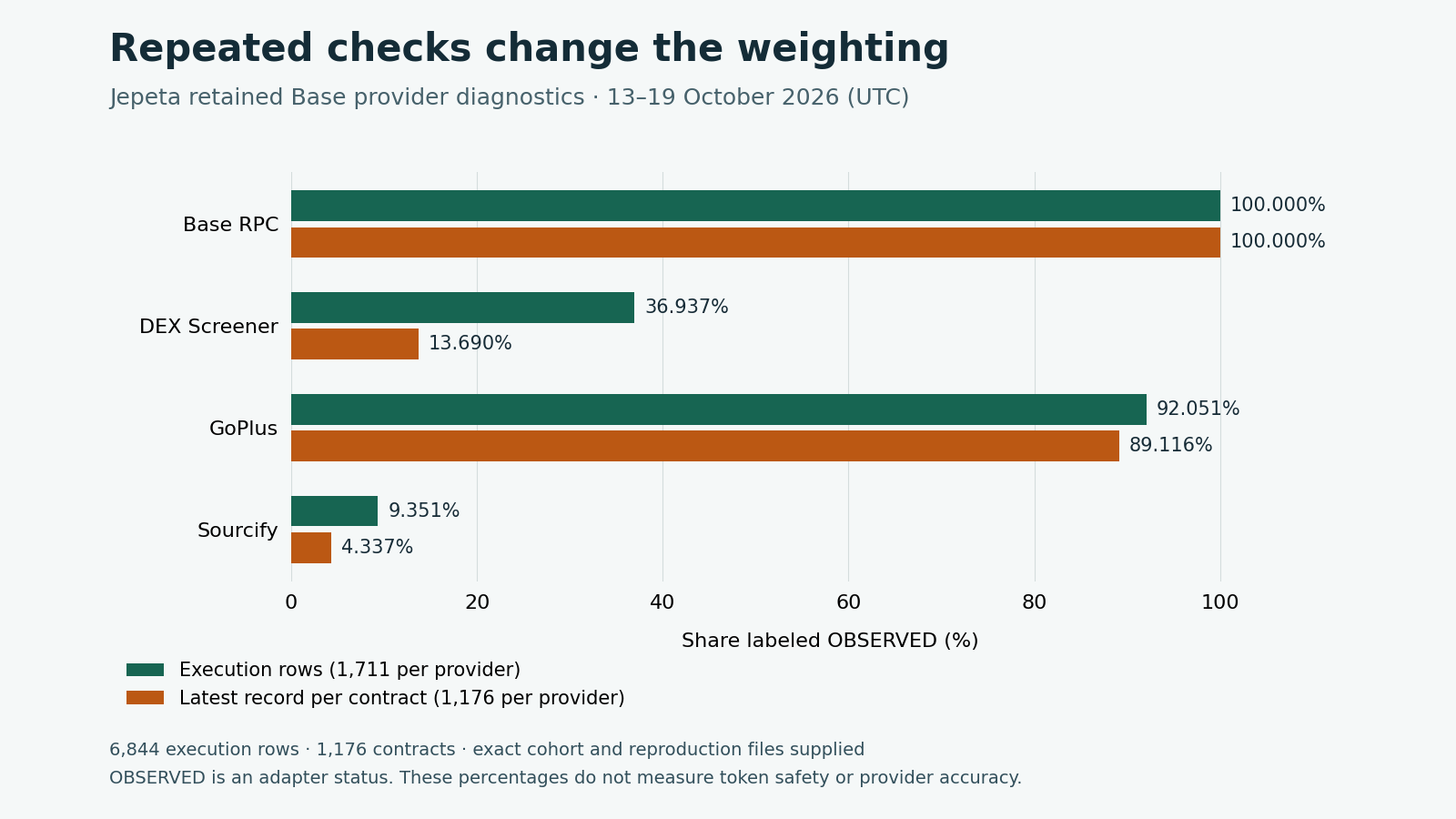
The same retained data can answer two questions: what share of logged executions had a status, and what share of distinct contracts had that status at their latest logged check? Repeated checks give some contracts more weight in the first calculation. The second gives each contract one record per provider. Neither is a random sample of Base.
The clearest difference in this cohort is DEX Screener: 632 of 1,711 execution rows are OBSERVED, or 36.937%. Keeping only the latest record for each contract leaves 161 OBSERVED records out of 1,176 contracts, or 13.690%. The difference is 23.247 percentage points. This is a change in weighting within the same export, not evidence that a provider improved or deteriorated over time.
Execution rows and latest-contract records
| Provider | OBSERVED execution rows / all retained rows | OBSERVED latest records / distinct contracts |
|---|---|---|
| Base RPC | 1,711 / 1,711 (100.000%) | 1,176 / 1,176 (100.000%) |
| DEX Screener | 632 / 1,711 (36.937%) | 161 / 1,176 (13.690%) |
| GoPlus | 1,575 / 1,711 (92.051%) | 1,048 / 1,176 (89.116%) |
| Sourcify | 160 / 1,711 (9.351%) | 51 / 1,176 (4.337%) |
OBSERVED is Jepeta's execution label. It does not mean every field is complete, the contract is safe, or the underlying response was independently verified. Equal totals across providers do not prove that their rows belong to the same request.
| Provider | Other retained execution statuses |
|---|---|
| Base RPC | None in the retained cohort |
| DEX Screener | PARTIAL 1,078; RATE_LIMITED 1 |
| GoPlus | PARTIAL 100; UNKNOWN 16; UNAVAILABLE 19; RATE_LIMITED 1 |
| Sourcify | UNKNOWN 1,551 |
All recorded states remain in their provider's denominator. Missing or unknown evidence is never turned into a negative security finding or a zero value. The chart and first table expose both denominators.
What these labels actually describe
The labels come from Jepeta's adapter and logging rules. In the inspected GoPlus adapter, missing required honeypot or mintability fields can produce PARTIAL. In the DEX Screener adapter, OBSERVED requires a matching selected market with a usable liquidity value; PARTIAL can cover a response without that complete context. A Sourcify not-found response can become UNKNOWN. These are different conditions, so a cross-provider percentage is not a like-for-like reliability benchmark.
The upstream documentation also has coverage boundaries. GoPlus documents omitted or null security fields when information is unknown. DEX Screener documents token and pair lookups. These references explain why field scope and exact market identity matter; they do not independently verify any historical response in this study.
Exact cohort and reproduction
The cohort includes every retained row in Jepeta's provider_executions table whose observed_at is at or after October 13, 2026 at 00:00 UTC and before October 20 at 00:00 UTC, exported on October 20. There is no status exclusion, token-name filter, liquidity threshold or risk-score filter. The export contains immutable row IDs 20,058 through 26,901 inclusive, with no missing or duplicate ID in that interval. Its four provider groups each contain the same 1,176 distinct contract addresses.
The public aggregate JSON supplies every status count and both denominators, plus the SHA-256 digest of the retained private cohort. Reproduction code recomputes the results JSON without network access. Run node reproduce-provider-aggregate.mjs provider-availability-aggregate-2026-10-20.json after downloading both files. Per-contract execution rows stay private; readers can reproduce the arithmetic publicly, but cannot independently verify cohort membership or latest-record selection from those aggregates.
For execution percentages, divide the count of a status by all retained rows for that provider. For the latest-contract calculation, group by provider and lowercase contract address, select the greatest observed_at, and break an exact timestamp tie by the greater row ID. Divide by that provider's distinct contract count. Multiply by one hundred and round only the final percentage to three decimal places. The recorded methodology version is preserved; no historical risk score is recalculated.
What the export cannot establish
These are first-party retained diagnostics. The live retention policy keeps provider execution diagnostics for eight days, with referenced evidence preserved separately, so the export is not a complete historical census of requests. Collection and retention can affect which contracts and checks remain. Repeated observations are correlated, and the latest check for one contract may occur at a different time from another contract's latest check. The retained private row set supports internal audit; the public release contains derived counts and limited provenance, not an upstream dataset mirror.
The export cannot establish provider accuracy, response-field correctness, token safety, market-wide coverage, human traffic, latency superiority, or a causal trend. It cannot pair providers by request: the exported table has no common request identifier. It also cannot be joined to the separate scan-row count as if both tables represented the same observations. The practical lesson is to name the unit, time window and missing-state rules beside any percentage before using it in a monitoring decision.
Jepeta evidence and method
- jepeta data — Internal read-only export of 6,844 retained provider-execution rows in a fixed UTC window, covering 1,176 distinct Base contracts. Public derived counts and a retained-cohort digest permit arithmetic reproduction without bulk redistributing provider data. · evidence · observed Oct 20, 2026
- calculation — Offline reproduction separates execution-row and latest-record-per-contract denominators, retains every recorded status, validates identity/window/counts and rounds final percentages to three decimal places. · evidence · observed Oct 20, 2026
Editorial transparency
This article was prepared with AI-assisted tools and an evidence-oriented source review. Citations and limitations are provided below. Documentation comparison is not a hands-on test; historical content is not automatically certified under the later independent editorial review process. Editorial standards and corrections.
Sources
- Jepeta derived provider-execution aggregate and retained-cohort digest, October 13–19, 2026 · primary · verified Oct 20, 2026
- Jepeta reproducible status and latest-contract calculations · primary · verified Oct 20, 2026
- Jepeta inspected adapter semantics and cohort method · primary · verified Oct 20, 2026
- GoPlus official response details and unavailable-field semantics · primary · verified Oct 20, 2026
- DEX Screener official token and pair API reference · primary · verified Oct 20, 2026