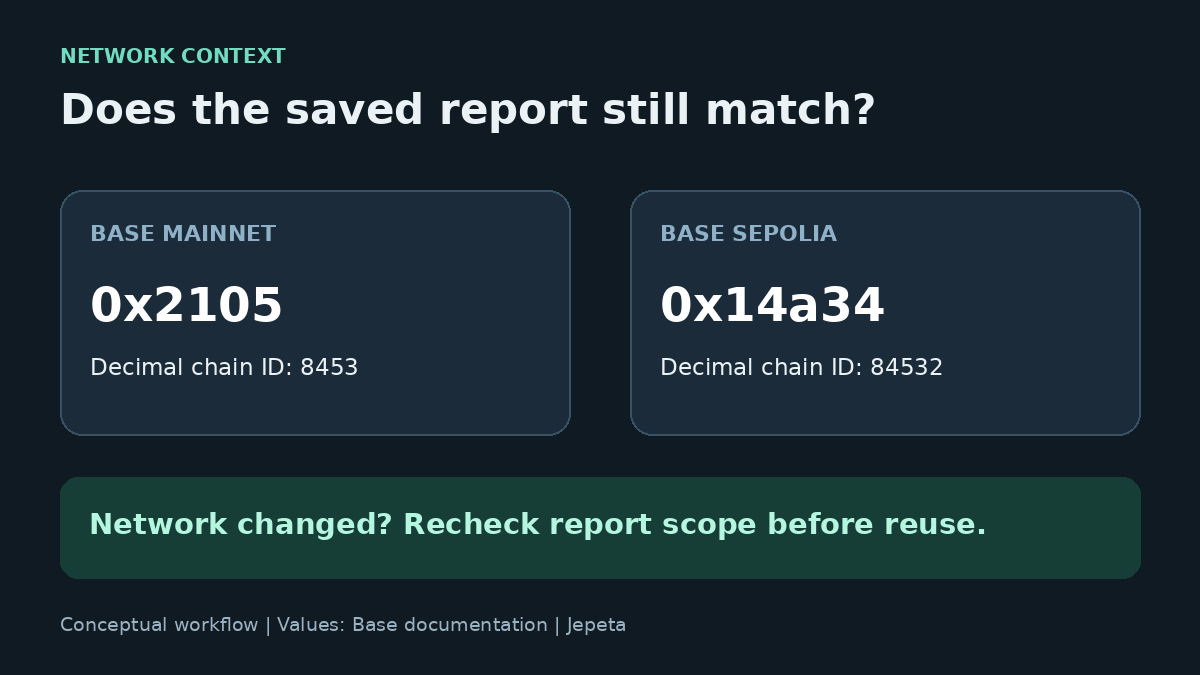
Read the identifier, not just the network label
EIP-695 defines `eth_chainId` as the way to read the configured chain ID. Its result is a hexadecimal representation of an integer. The specification recommends using it rather than `net_version` to identify the chain being contacted. For a reader comparing a provider with a saved report, the useful question is whether their chain identities match, not whether two interfaces display a similar name.
Base Mainnet and Sepolia are different contexts
Base's method reference gives these documented values:
| Network | Hexadecimal chain ID | Decimal chain ID |
|---|---|---|
| Base Mainnet | `0x2105` | `8453` |
| Base Sepolia | `0x14a34` | `84532` |
The decimal and hexadecimal entries in each row are two representations of the same identifier. The rows describe separate networks. These are documentation values, not readings from your wallet.
A changed account is a different signal
EIP-1193 separates `chainChanged`, which reports the provider's connected chain changing, from `accountsChanged`, which reports a change to the accounts available to it. Seeing an account update therefore does not establish that the chain stayed the same. The standard also requires the provider's `eth_chainId` result to reflect its configured chain. This describes the interface contract; it does not verify how a particular wallet behaves.
Use a report-context checklist after a switch
The following is a practical reading workflow derived from those interface definitions:
- Read the chain ID again and compare it with the report's stated network.
- Compare the exact contract address in the report with the asset you intend to inspect on that chain.
- Check the report's observation time and any missing-source notices.
- If the chain differs, stop using that report as evidence for the newly selected network and request a report with the correct scope.
A matching network is necessary context, not a conclusion about the asset. Keep those decisions separate.
Switching back does not update an old report
Returning to the original network can resolve an identity mismatch. It does not, by itself, collect fresh observations or complete a missing check in a saved report. Keep the network comparison separate from the report's date and source coverage. Our guide to token data quality explains how to read missing and partial evidence; this checklist adds the network-switch question before that review.
What this check can establish
The documented chain ID can help identify which network a provider is configured to contact. It cannot establish the truth of every response returned through that provider or determine whether a token is suitable for a transaction. This article compares published specifications and documentation. No wallet was connected, no transaction was signed, and no specific token was evaluated.
Evidence and source-review method
- source audit — Compared the chain-identity method, provider event definitions and Base network values; independently recomputed both hexadecimal/decimal mappings and derived a report-applicability checklist. No live wallet or transaction test is claimed. · evidence · observed Oct 18, 2026
Editorial transparency
This article was prepared with AI-assisted tools and an evidence-oriented source review. Citations and limitations are provided below. Documentation comparison is not a hands-on test; historical content is not automatically certified under the later independent editorial review process. Editorial standards and corrections.
Sources
- EIP-695: eth_chainId · primary · verified Oct 18, 2026
- EIP-1193: provider events · primary · verified Oct 18, 2026
- Base: documented chain IDs · primary · verified Oct 18, 2026
- Jepeta: data quality and source completeness · jepeta · verified Oct 18, 2026